Why Mosquito Killers Stop Working After a Few Months: What Customers Experience on Amazon
六月 15, 2026
Many customers report that mosquito killers work well at first but gradually lose effectiveness or stop working after a few months. Based on Amazon review analysis, this issue is often linked to component quality, UV degradation, and internal system failure.
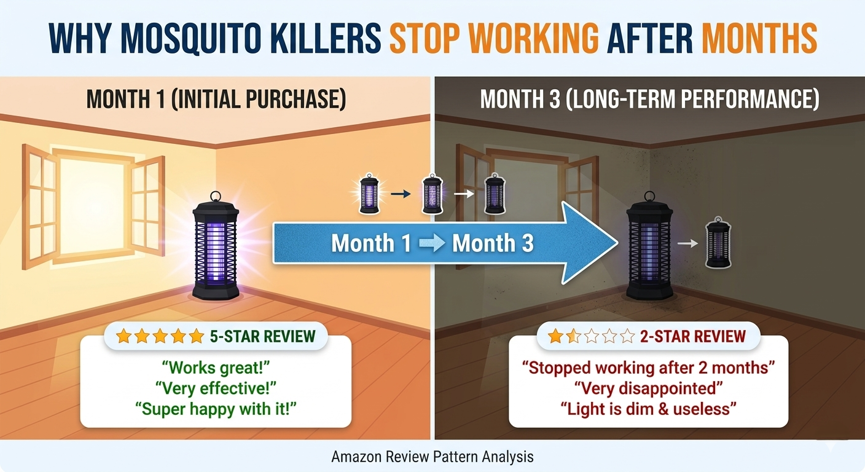
Why Mosquito Killers Stop Working After a Few Months
One of the most common complaints in mosquito killer reviews is short product lifespan.
Customers often describe the same pattern:
- Works well at the beginning
- Gradual decline in performance
- Eventually stops working or becomes ineffective
This raises an important question: why do mosquito killers fail after only a few months of use?
Based on customer feedback and product behavior patterns, several key reasons emerge.
1. UV Light Degradation Over Time
Most mosquito killers rely on UV light to attract insects.
However, UV tubes or LED sources can degrade over time.
When UV intensity decreases:
- Mosquito attraction becomes weaker
- Catch rate drops significantly
- Users may think the device has “stopped working”
Many customers do not realize that UV output naturally weakens with usage, especially in low-quality components.
2. Ballast or Power Supply Failure
Another major cause of failure is the internal power system.
Mosquito killers often rely on:
- Ballasts
- Drivers
- Voltage conversion modules
If these components are not stable, the device may:
- Fail to ignite UV tubes
- Produce inconsistent voltage
- Shut down intermittently
Customers often describe this as:
- “It turns on but doesn’t kill mosquitoes anymore”
- “Light is dim or flickering”
- “Stopped working suddenly”
3. Dust and Insect Buildup Inside the Device
Over time, dust and insect debris accumulate inside the unit.
This can cause:
- Blocked airflow
- Overheating
- Electrical interference
- Reduced efficiency of internal components
In some cases, overheating can accelerate component aging, leading to earlier failure.
4. Cheap Internal Components
A significant portion of low-cost mosquito killers use:
- Low-grade capacitors
- Weak wiring insulation
- Unstable plastic housings
- Low-quality UV tubes
These components may work initially but degrade quickly under continuous outdoor or high-temperature use.
Customers often notice:
- Short product lifespan
- Sudden breakdown
- Inconsistent performance after a few weeks
5. Environmental Stress (Outdoor Use)
Outdoor environments are harsh on mosquito killers.
Factors include:
- High humidity
- Rain exposure
- Temperature fluctuations
- Dust and wind
If the product is not properly sealed or weather-resistant, internal components can degrade much faster than expected.
What Customers Expect
From review analysis, customers are not expecting industrial-grade lifetime performance.
However, they do expect:
✓ Stable performance for at least one mosquito season
✓ No sudden breakdowns
✓ Consistent UV output
✓ Reliable electrical system
✓ Weather-resistant design for outdoor use
When these expectations are not met, customers perceive the product as “low quality” or “stopped working quickly.”
What Manufacturers Can Learn
Product lifespan is not just about one component—it is a system-level design issue.
Improvements that significantly increase durability include:
- High-stability UV light sources (reduced degradation rate)
- Better ballast and driver design
- Improved thermal management
- Dust-proof internal structure
- Outdoor-rated sealing materials
Extending product lifespan directly improves customer satisfaction and reduces negative reviews.
Conclusion
Mosquito killers often stop working after a few months not because of a single failure point, but due to a combination of UV degradation, electrical instability, and environmental stress.
For manufacturers, improving durability is one of the most effective ways to reduce complaints and build long-term brand trust.
A mosquito killer that lasts longer is not just a better product—it is a stronger business asset.