Why Coverage Area Claims Disappoint Customers: The Truth Behind Mosquito Killer Coverage
六月 18, 2026
Many mosquito killer customers feel disappointed when the product does not protect the advertised area. After analyzing mosquito killer reviews, we found that coverage claims are often misunderstood due to environment, product design, and mosquito behavior.
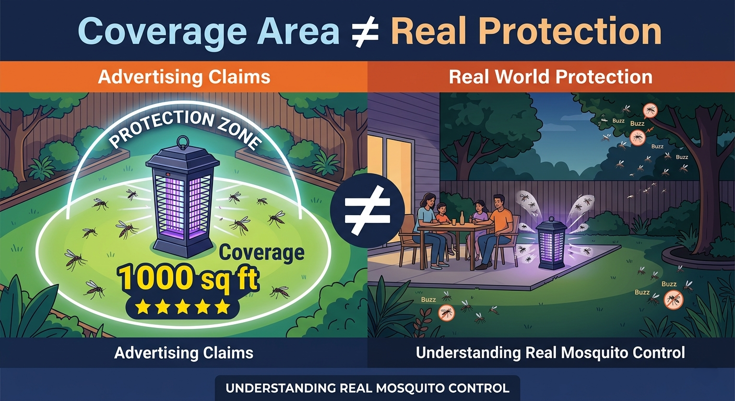
Why Coverage Area Claims Disappoint Customers
When buying a mosquito killer, one of the first things customers look at is coverage area.
A product may claim:
- Covers large outdoor spaces
- Protects your entire patio
- Suitable for large rooms
However, many users later report:
- "It doesn't cover the area advertised."
- "Mosquitoes are still everywhere."
- "Works only when mosquitoes are very close."
Why does this happen?
The answer is more complicated than just product power.
1. Coverage Area Is Not a Fixed Number
Many customers assume coverage works like a Wi-Fi signal:
A device with a larger coverage rating should protect every corner.
But mosquito control does not work that way.
Mosquito movement depends on:
- Air movement
- Temperature
- Humidity
- Light conditions
- Mosquito density
- Placement location
A mosquito trap does not create an invisible barrier.
It attracts insects within an effective range.
2. UV Attraction Has a Practical Limit
Most mosquito killers use UV light to attract flying insects.
However, attraction strength decreases with distance.
The farther mosquitoes are from the device:
- The weaker the UV influence
- The less noticeable the attraction
- The longer it may take for insects to approach
This is why simply increasing the claimed coverage area does not always improve results.
A well-designed product focuses on effective attraction performance, not only larger numbers.
3. Outdoor Environments Are More Challenging
Outdoor mosquito control is much harder than indoor use.
Outdoor conditions include:
- Wind
- Open space
- Competing light sources
- Vegetation
- Multiple mosquito entry points
A mosquito killer placed on a patio will face very different conditions compared with a closed room.
Customers often become disappointed when indoor expectations are applied to outdoor environments.
4. Placement Has a Major Impact
Even a powerful mosquito killer can perform poorly if placed incorrectly.
Common mistakes include:
- Putting the device too close to people
- Installing it near strong lights
- Placing it behind obstacles
- Keeping it too far from mosquito activity areas
The best placement depends on mosquito behavior and the environment.
5. Larger Products Do Not Always Mean Better Coverage
Some customers believe:
"Bigger unit = larger protection area."
But actual performance depends on:
- UV wavelength quality
- Light intensity stability
- Electrical system design
- Airflow design
- Insect access structure
A smaller, well-engineered mosquito trap may outperform a larger product with weaker attraction efficiency.
What Customers Really Want
From customer reviews, users are not only looking for a bigger coverage number.
They want:
✓ Real-world effectiveness
✓ Consistent mosquito attraction
✓ Honest performance expectations
✓ Suitable recommendations for different environments
Clear communication between brands and customers is important.
What Manufacturers Can Learn
Coverage claims should be based on realistic usage scenarios.
Better product development focuses on:
- Stable UV output
- Optimized insect attraction design
- Proper airflow
- Environmental testing
A successful mosquito killer is not defined by the biggest coverage claim.
It is defined by how reliably it performs in real customer environments.
Conclusion
Coverage area is one of the biggest reasons customers feel disappointed with mosquito killers.
The gap between advertised coverage and real-world performance often comes from misunderstanding how mosquito attraction actually works.
For manufacturers, accurate positioning and better engineering are the keys to building customer trust.