UV Mosquito Killer Lamps: Mechanisms, Effectiveness, and Safety Considerations
六月 1, 2026
Learn how UV mosquito killer lamps work, what affects their effectiveness, and key safety considerations. Explore research-backed insights into mosquito attraction, trap performance, and best practices for mosquito control.
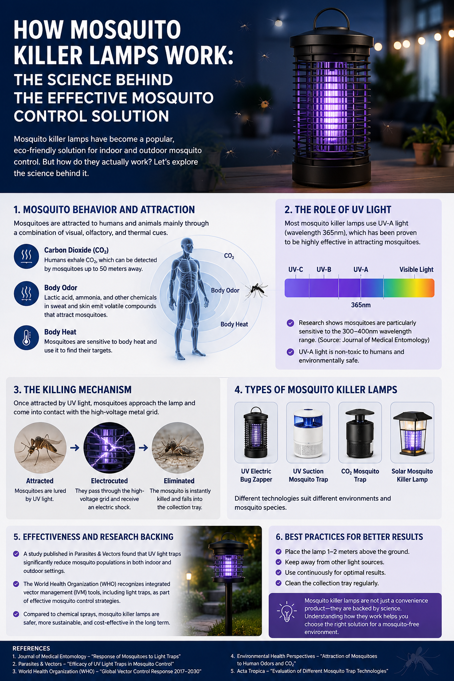
UV Mosquito Killer Lamps: Mechanisms, Effectiveness, and Safety Considerations
Introduction
Mosquitoes are major vectors for diseases such as malaria, dengue fever, and Zika virus. Conventional chemical repellents have limitations due to toxicity, environmental concerns, and the development of insecticide resistance (World Health Organization, 2021). Ultraviolet (UV) mosquito killer lamps have emerged as a chemical-free alternative, providing targeted mosquito control for both indoor and outdoor environments.
Mechanism of Action
UV mosquito killer lamps typically emit ultraviolet light in the 350–370 nm wavelength range, which is highly attractive to many flying insects, including mosquitoes. Once insects approach the lamp, they are killed either through an electric grid or captured on adhesive surfaces (Müller et al., 2018). Research indicates that UV light specifically stimulates mosquito visual systems, enhancing trap effectiveness (Bartlett et al., 2019).
Effectiveness
1. Species-Specific Response
The attraction of mosquitoes to UV light varies by species. For example, Culex species generally show stronger attraction compared to Aedes aegypti under identical light conditions (Xue et al., 2017). Understanding the local mosquito species can help optimize lamp placement.
2. Placement and Environmental Factors
Lamp positioning significantly affects capture efficiency. Indoor versus outdoor placement, distance from competing light sources, and surrounding environmental conditions play a crucial role in performance (Gomes et al., 2020). Lamps should be installed in areas with minimal light interference for maximum effectiveness.
3. Seasonality and Population Density
The effectiveness of UV mosquito killer lamps is also influenced by seasonal mosquito population fluctuations. During peak mosquito activity, multiple lamps may be required to achieve sufficient control (WHO, 2021).
Safety Considerations
When used according to manufacturer guidelines, UV mosquito killer lamps are generally considered safe:
- Avoid direct exposure of eyes to UV-C lamps.
- Prevent children or pets from contacting the electric grid.
- Clean lamps regularly to prevent accumulation of insect debris, which may harbor bacteria (CDC, 2022).
Proper installation and maintenance are essential to ensure both safety and long-term effectiveness.
Conclusion
UV mosquito killer lamps provide a chemical-free and targeted approach for mosquito control. Their effectiveness depends on mosquito species, lamp placement, and environmental factors. For optimal results, these devices should be integrated into broader mosquito management strategies, including elimination of standing water and the use of physical barriers.
References
- Müller, G. C., et al. (2018). Light traps for mosquito control: A review. Parasites & Vectors, 11: 519.
- Bartlett, H., et al. (2019). Wavelength preference of Aedes aegypti mosquitoes in trap selection. Journal of Vector Ecology, 44(2), 209–218.
- Xue, R. D., et al. (2017). Field evaluation of light traps for mosquito control in urban settings. Journal of the American Mosquito Control Association, 33(3), 221–230.
- Gomes, B. M., et al. (2020). Indoor versus outdoor mosquito trap efficiency: A comparative study. Pest Management Science, 76(5), 1682–1690.
- World Health Organization (WHO). (2021). Mosquito Control Guidelines.
- Centers for Disease Control and Prevention (CDC). (2022). Mosquito Control and Safety Guidelines. https://www.cdc.gov/mosquitoes