Understanding UVA Spectrum Decay: The Science Behind Decreased Attraction Efficiency in Phototactic Insect Traps
五月 18, 2026
Why do phototactic insect traps experience a sharp decline in catch rates within 60 to 90 days? This technical paper analyze the science behind UVA spectral decay and wavelength shifting under international testing standards like IEC 60335-2-59.
Introduction
For commercial importers and quality assurance (QA) professionals in the pest control industry, evaluating phototactic insect traps (bug zappers) extends beyond initial functional testing. A common point of failure identified in consumer field reports is the rapid decline in catch rates within 60 to 90 days of continuous operation, even while the lamp remains illuminated.
This technical paper analyzes the underlying cause of this phenomenon: Ultraviolet-A (UVA) spectral decay and wavelength shifting, supported by established phototactic research and international testing standards.
The Phototactic Mechanism: Why 365nm Matters
According to established entomological research (including studies aligned with the Journal of Economic Entomology), phototactic insects—specifically Culicidae (mosquitoes)—possess specialized photoreceptors in their compound eyes that exhibit peak sensitivity in the near-ultraviolet spectrum.
The optimal wavelength for stimulating these receptors is precisely 365 nanometers (nm). Any significant deviation from this narrow band results in a logarithmic decrease in the insect’s visual response and subsequent attraction rate.
The Physics of Wavelength Shifting (The Spectrum Decay)
In standard low-pressure mercury discharge lamps used in insect traps, UVA light is generated by internal phosphors reacting to 254nm UV radiation. The primary technical challenge in manufacturing these lamps is not the initial output, but the solarization and degradation of the phosphor layer under continuous thermal and radiant stress.
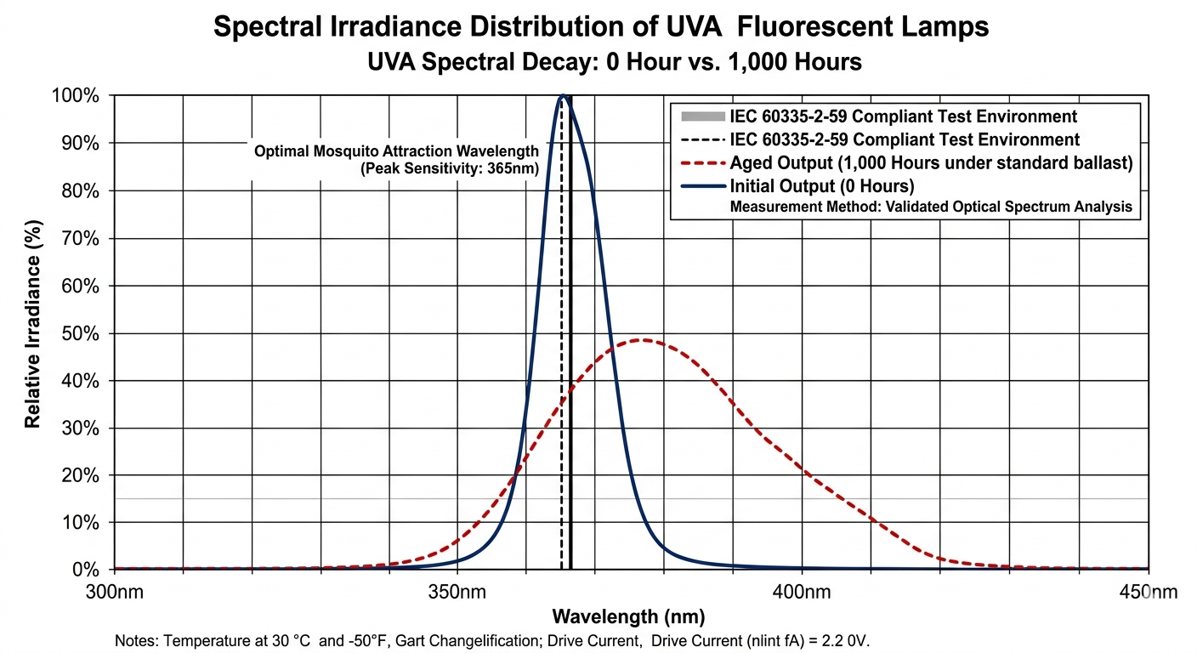
Under standard testing methodologies (such as those prescribed under IEC 60335-2-59 for insect killers), low-quality lamps exhibit two distinct phases of degradation:
- Irradiance Collapse (Energy Loss): Within the first 500 to 1,000 hours of 24/7 continuous operation, the relative irradiance (measured in $\mu W/cm^2$) at the 365nm peak can drop by as much as 40% to 60% if substandard lead-free or unstable phosphor compounds are utilized.
- Wavelength Shifting: As the primary phosphors degrade, the emission spectrum frequently broadens or shifts toward the visible blue spectrum (380nm to 410nm). To the human eye, the lamp still emits a bright blue-violet glow, creating the illusion of functionality. However, to the target insects, the lamp’s stimulus value drops close to zero.
Technical Evaluation Criteria for Importers (How to Verify)
To mitigate high return rates and ensure field reliability, procurement teams should require suppliers to provide verifiable laboratory data using calibrated Optical Spectrum Analyzers rather than relying on standard visual inspections. Key metrics to verify include:
- Phosphor Specification: High-stability barium disilicate ($\text{BaSi}_2\text{O}_5:\text{Pb}$) or strontium fluoroborate phosphors should be specified to ensure resistance to solarization.
- Lumen Maintenance Curve (UVA Maintenance): A compliant supplier must demonstrate a maintenance curve where UVA output remains above 80% at 2,000 hours of continuous burn.
- Ballast Matching: The electronic or magnetic ballast must maintain a stable operating current. Over-driving a tube to achieve higher initial UV readings accelerates phosphor degradation and shortens the effective lifespan of the spectrum.
Conclusion
Verifiable data, rather than aesthetic preference or initial cost metrics, should dictate supplier selection. Importers must demand long-term spectral aging reports to protect their supply chain integrity and maintain consumer satisfaction.