Navigating the Regulatory Landscape: A Roadmap to Compliance for North American Insect Killers
五月 10, 2026
In the high-stakes B2B market, compliance is more than just a label—it's a legal shield. This white paper outlines the essential regulatory framework for 2026, including EPA establishment requirements, UL/ETL safety standards, and Prop 65 chemical compliance. Learn how Kolma mitigates customs risks and platform delisting for our global partners.
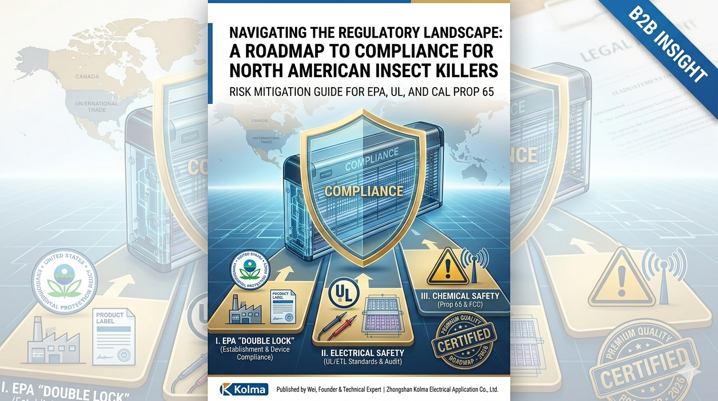
Navigating the Regulatory Landscape: A Roadmap to Compliance for North American Insect Killers
Introduction: For North American distributors and retailers, the cost of non-compliance far outweighs the savings of a cheaper unit. In 2026, with the EPA (Environmental Protection Agency) and CBP (Customs and Border Protection) tightening inspections on "Pesticide Devices," procurement is no longer just about performance—it is about risk management.
At Kolma, we view compliance not as a hurdle, but as a competitive moat. This white paper details the "Double Lock" system required for legal success in the U.S. market.
I. The EPA "Double Lock": Establishment vs. Registration
1. The Common Pitfall
Many buyers mistakenly believe that an EPA Establishment Number alone is sufficient. However, for electronic insect killers (classified as "Pesticide Devices"), the distinction is critical.
2. The Kolma Standard
- EPA Establishment Number: This proves the factory is a legitimate facility recorded by the EPA.
- Device Compliance: Unlike chemical pesticides, devices do not require a "Registration Number" but must strictly adhere to labeling and claims regulations.
- Our View: We ensure all QH-series products avoid "unsubstantiated claims" (e.g., claiming to kill viruses or specific disease-carrying mosquitoes without trial data), which is the #1 reason for Amazon delisting and Customs seizure.
II. Electrical Safety: Beyond the UL Logo
1. The Shift to UL 1559
Commercial insect killers must meet UL 1559 (Insect Control Equipment). A common risk in the industry is "Component-only certification," where a factory uses a UL-listed cord but the entire unit remains uncertified.
2. The Resilience Factor
- Enclosure Testing: Under UL 746C, the plastic must withstand specific impact and thermal stress without exposing high-voltage grids.
- Continuous Audit: Kolma maintains rigorous quarterly factory audits to ensure that the production unit is identical to the lab-tested prototype.
III. The "Hidden" Requirements: Prop 65 & FCC
1. California Proposition 65
If your product contains lead in the solder or specific phthalates in the power cord, it requires a "Clear and Reasonable Warning" in California. Failure to do so leads to "60-day notices" and massive legal settlements.
2. FCC Part 15
For models using electronic ballasts, Electromagnetic Interference (EMI) must be controlled. Our QH-series undergoes Part 15 testing to ensure they do not interfere with other commercial wireless systems or medical equipment.
Conclusion: Compliance as a Moat
In 2026, the complexity of the North American regulatory environment will only increase. A professional supplier must be a Regulatory Partner.
Kolma’s Commitment:
- Pre-shipment Compliance Audit: Every batch is checked against the latest CBP (Customs) entry requirements.
- Documentation Transparency: All test reports and EPA filings are available to our partners via a secure portal.
Choosing a compliant partner like Kolma means choosing market continuity.
Authored by Wei, Founder of Zhongshan Kolma Electrical Application Co., Ltd.